
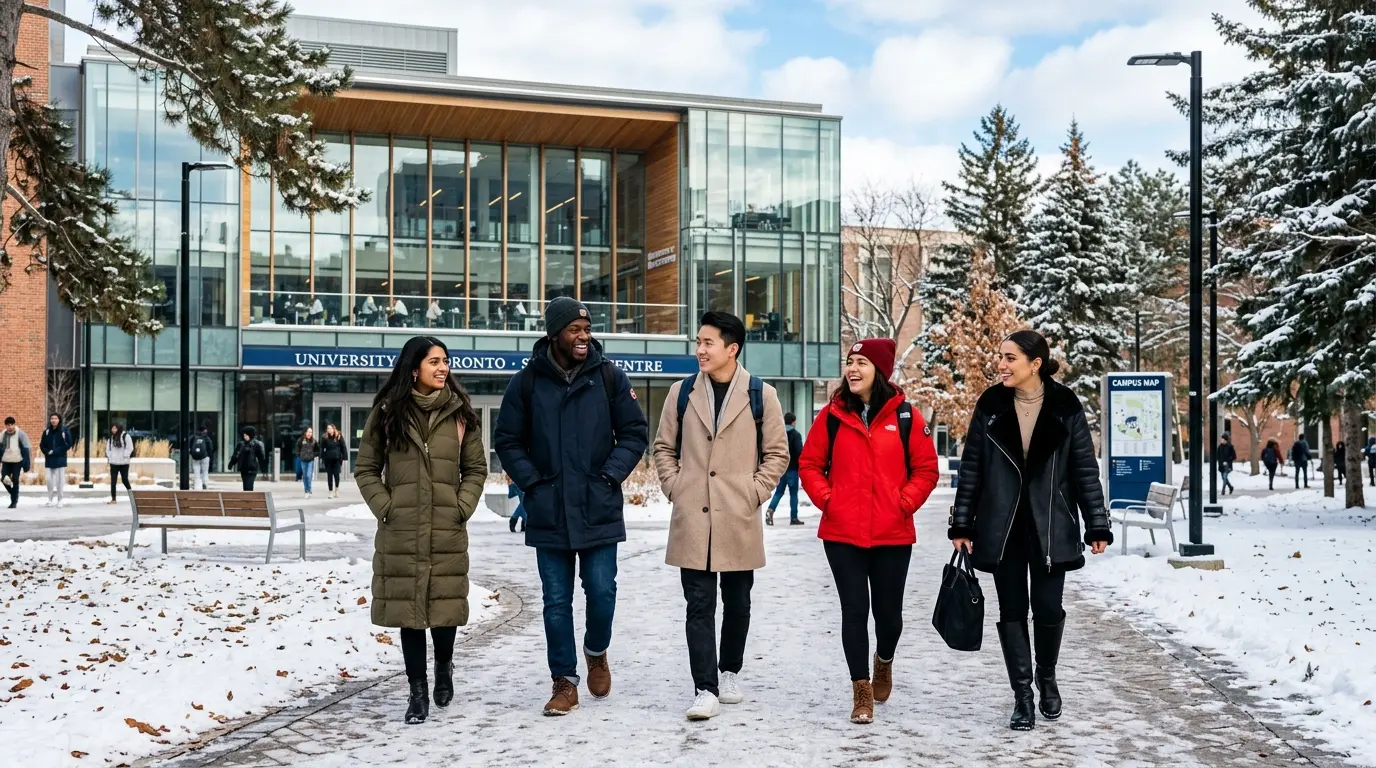
Canada remains one of the most attractive study destinations for Indian students seeking world-class education, multi-cultural post-secondary campuses, and transparent pathways toward Permanent Residency (PR) via Express Entry. However, the regulatory environment governing Canadian Study Permits, Post-Graduation Work Permits (PGWP), and family reunification has undergone significant recalibration.
Under Minister of Immigration guidelines, Canada has transitioned from volume-driven recruitment to a strategic, outcome-oriented model. The total national target for new study permits is capped, Provincial Attestation Letters (PAL) are strictly rationed, and financial proof thresholds have been adjusted to reflect true Canadian inflation and housing costs.
In this advisory guide, our Canadian immigration experts unpack IRCC's official policy directives, analyze the strategic choice between public university degrees vs. college diplomas, outline financial compliance strategies, and map out post-study PR pathways for Indian graduates.
1. GIC Financial Requirement Raised to CAD $23,448
For several years, IRCC maintained a static cost-of-living requirement of CAD $10,000 per student. However, recognizing real-world living costs in urban centers such as Toronto, Vancouver, Montreal, and Calgary, IRCC indexed the financial requirement to Statistics Canada's Low-Income Cut-Off (LICO).
In addition to the $23,448 GIC deposit, Indian applicants must demonstrate:
- First-Year Full Tuition Payment: Official receipt from your Designated Learning Institution (DLI) confirming 100% payment of Year 1 tuition (typically CAD $18,000 to $38,000 depending on university vs. college).
- Travel & Contingency Funds: Documented liquid savings or bank balance showing an additional CAD $2,000 to $3,000 for travel and initial settling expenses.
- Proof of Family Income: Parent Income Tax Returns (ITR-V for 3 years) demonstrating sustainable recurring annual income to support Year 2 expenses.
Need support arranging sanctioned education loans to cover your $23,448 GIC and tuition? Connect with our specialized Canadian Student Loan & GIC Advisory Desk.
2. Post-Graduation Work Permit (PGWP) Rules 2026: University vs. College
The Post-Graduation Work Permit (PGWP) is the vital bridge enabling international graduates to gain Canadian work experience (NOC TEER 0, 1, 2, or 3) necessary for Express Entry Canadian Experience Class (CEC) and Provincial Nominee Programs (PNP).
The Critical Difference: Degree vs. Non-Degree Programs
| Qualification Level | Field of Study Restrictions | Language Requirement | PGWP Duration Issued |
|---|---|---|---|
| Master's & PhD Degrees | 100% EXEMPT (Any academic discipline eligible) | CLB 7 (IELTS 6.0 in all bands) | 3-Year PGWP (even for 16-month intensive programs) |
| Bachelor's Degrees (University) | 100% EXEMPT (Any academic discipline eligible) | CLB 7 (IELTS 6.0 in all bands) | 3-Year PGWP (for 4-year programs) |
| College Diplomas / Certificates | STRICTLY RESTRICTED (Must match shortage CIP codes) | CLB 5 (IELTS 5.0 in all bands) | Equal to length of study (1 to 2 Years) |
Eligible Labor Shortage Sectors for College Diplomas
If an Indian student enrolls in a college diploma or post-graduate certificate program, their program's official 6-digit Classification of Instructional Programs (CIP) code must belong to one of 5 target economic shortage streams confirmed by IRCC:
- 1. Science, Technology, Engineering & Math (STEM): Software engineering, cloud infrastructure, cybersecurity, civil technology, mechanical design, data management.
- 2. Healthcare & Life Sciences: Practical nursing, medical laboratory technology, elder care administration, pharmacy technician programs.
- 3. Skilled Trades: Electrical engineering technology, plumbing, HVAC installation, heavy equipment technology.
- 4. Transport & Logistics: Aviation maintenance technology, commercial marine management, supply chain operational management.
- 5. Agriculture & Agri-Food: Food science technology, agricultural robotics, sustainable crop management.
3. Spousal Open Work Permit (SOWP) Ban & Restrictions
One of the most consequential policy changes affects married Indian applicants planning to travel to Canada with their spouse. In previous years, spouses of all international students were eligible for an open work permit. Under current IRCC regulations, eligibility has been significantly restricted.
Who Qualifies for a Spousal Open Work Permit in 2026?
- ✅ Eligible: Spouses of students enrolled in Master's degree programs lasting 16 months or longer at an eligible Canadian university.
- ✅ Eligible: Spouses of students enrolled in Doctoral (PhD) degree programs.
- ✅ Eligible: Spouses of students enrolled in select professional university programs (e.g., Doctor of Medicine [MD], Juris Doctor [JD], Bachelor of Science in Nursing [BSN], Doctor of Pharmacy [PharmD]).
- ❌ Ineligible: Spouses of students enrolled in undergraduate college diplomas, post-graduate certificates, or general Bachelor's degrees.
- ❌ Final Term Restriction: Spouses of international students in their final academic semester are barred from filing new SOWP applications or extensions.
4. 24-Hour Off-Campus Work Limit & Compliance Audits
During the pandemic, temporary waivers permitted international students to work full-time hours off-campus. IRCC has permanently ended temporary waivers and instituted a strict permanent rule:
- Academic Term Limit: Maximum 24 hours per week of off-campus employment while classes are in session.
- Scheduled Breaks: Full-time employment (up to 40 hours per week) is authorized strictly during official university/college scheduled breaks (e.g., Summer semester for non-year-round programs, Winter holidays, and Reading Week).
- Social Insurance Number (SIN) Monitoring: Canada Revenue Agency (CRA) payroll records are digitally linked with IRCC databases. Exceeding 24 hours per week during term time triggers automatic compliance flags, risking study permit revocation and future PGWP inadmissibility.
Explore our detailed guide on 7 Fast-Track Canadian PR Pathways for STEM & Healthcare Graduates.
5. Step-by-Step Canada Study Permit Filing Roadmap
Step 1: Obtain Acceptance & Provincial Attestation Letter (PAL)
Secure your official Letter of Acceptance (LOA) from an eligible DLI. For college diploma and Bachelor's programs, request your DLI to issue your Provincial Attestation Letter (PAL) confirming your spot under the provincial allocation cap.
Step 2: Purchase CAD $23,448 GIC & Pay Year 1 Tuition
Transfer CAD $23,448 to your GIC account at Scotiabank, ICICI Canada, or SBI Canada to receive your official GIC Confirmation Certificate. Pay your first-year tuition fee and download the official DLI receipt.
Step 3: Complete Upfront Medical Exam & Biometrics
Book your upfront panel physician medical exam in India (Apollo Hospitals, Max Healthcare, or Fortis). Complete biometrics (fingerprints and photo) at a VFS Global center in India.
Step 4: Draft a Winning Statement of Purpose (SOP / Letter of Explanation)
Submit a strong, personalized SOP establishing: (1) academic progression from Indian qualifications, (2) why Canada over India, (3) clear financial solvency, and (4) genuine temporary intent to return to India. Get expert assistance via our SOP & Profile Building Desk.
Step 5: Submit Online via IRCC Secure Portal
Upload all verified documents (LOA, PAL, GIC Certificate, Tuition Receipt, Academic Transcripts, IELTS TRF, SOP) through the official IRCC portal (canada.ca).
Global Study Destination Comparison 2026
How does Canada compare against other top international education destinations for Indian students?
- Canada: CAD $23,448 GIC requirement, PAL cap system, 3-year PGWP for Master's/STEM diploma grads, clear Express Entry PR points. Check our destination overview on Studying in Canada.
- United States: In-person consular interview mandatory, Section 214(b) nonimmigrant intent scrutiny, 3-Year STEM OPT work permit. Read our recent guide on US F-1 Visa Interview Waiver Rules & Approval Strategy 2026.
- Germany: Zero tuition at public universities, €11,904 blocked account, 18-month jobseeker visa. Explore 8 Low-Tuition Public Universities in Germany.
- Australia: Evidence Level 3 strict document audit, AUD $29,710 living proof, Genuine Student (GS) requirement. Review our guide to Australia Subclass 500 Visa 2026 Rules.